

Taxonomy
"How are business concepts classified and organized?"
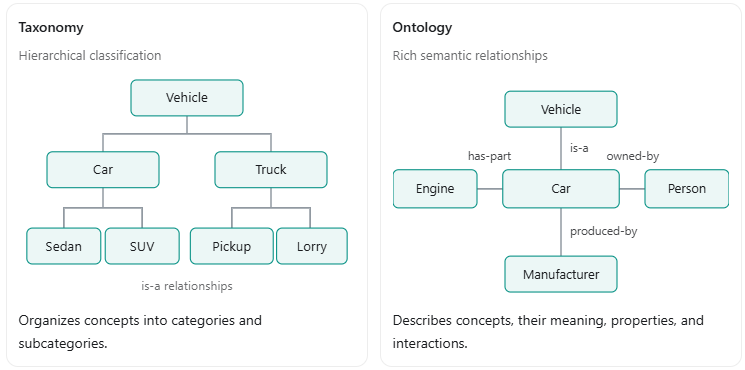
A taxonomy is a foundational component of semantic modeling and ontology design. It organizes business concepts into a structured classification system, typically through hierarchical relationships, progressing from general categories to more specific ones. It establishes a common vocabulary and provides a consistent way to categorize, organize, and navigate enterprise information.
While a taxonomy primarily focuses on classification and hierarchical relationships, an ontology goes further by defining properties, multiple types of semantic relationships, constraints, and logical axioms. A taxonomy can therefore exist independently or be incorporated into a richer ontology. It facilitates data discovery, classification, search, governance, and consistent interpretation of information by both humans and AI agents.
Hackolade Studio's technology-independent Polyglot modeling capabilities already provide building blocks for defining taxonomies through supertype/subtype hierarchies, multiple specialization axes, and completeness and exclusivity rules. Its business glossary capabilities complement this by establishing standardized business terminology and definitions.
The addition of RDFS, OWL, and SHACL capabilities extends this foundation toward formal ontology representation and machine-interpretable constraints.
From a strategic positioning perspective, taxonomies, semantic models, and ontologies are complementary forms of semantic metadata, all of which can be designed, maintained, governed, and transformed within a unified modeling environment, then operationalized through semantic layers and knowledge graphs.