

Mixed strategies inside supertype group
Setting the strategy at the level of the supertype group is a convenience: you set the value once, and it gets applied to all of its subtypes. They are all treated identically.
But it may wish to configure them differently, so that a given subtype gets materialized differently from the others. The strategy can then be set at the level of a single subtype.
Setting an exception
Every subtype of a group contains its own Strategy property, set by default to Inherited from group strategy. If you change it, that subtype alone stops following the group adopts the specified strategy:
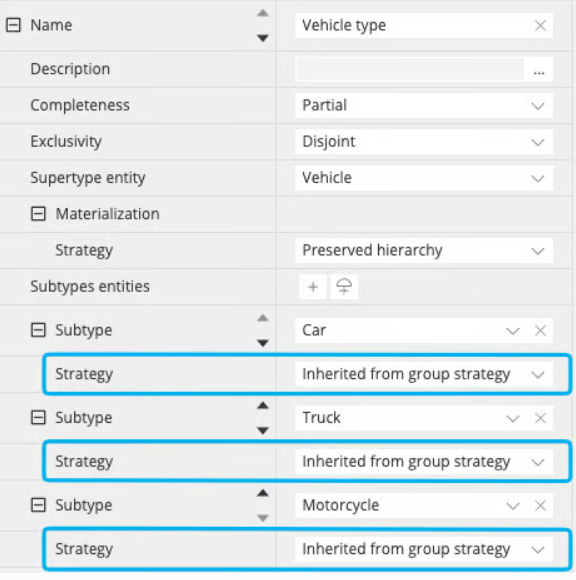
The value set for a subtype always wins over the one set at the level of the group.
Our example
Take the Vehicle supertype group. The entity Vehicle is the supertype, with the entities Car, Truck, and Motorcycle as subtypes:
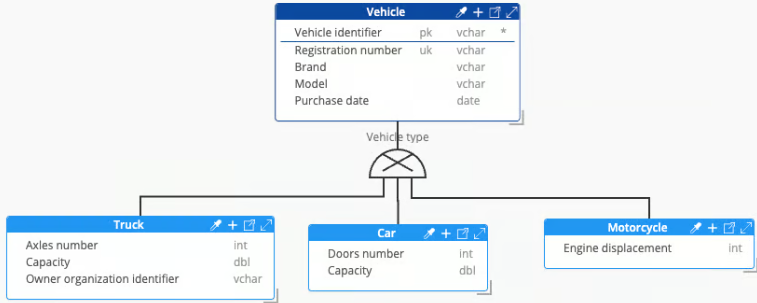
In this example, cars and motorcycles are company vehicles assigned to employees, and they are managed together, alongside the rest of the fleet. Trucks, on the other hand, are handled by another system, which expects one self-contained table, and knows nothing about our own hierarchy.
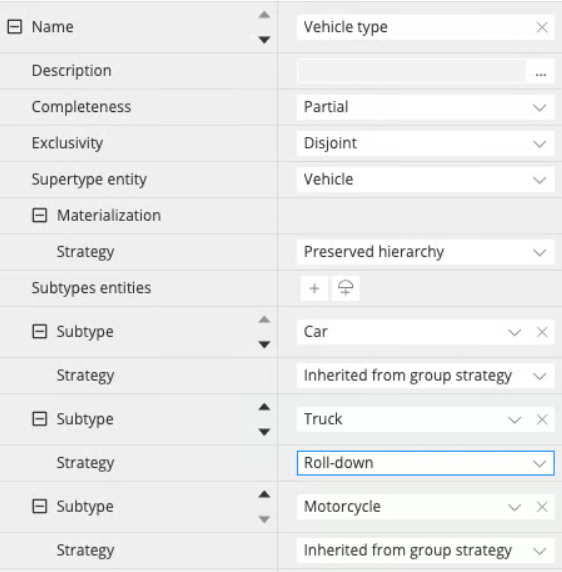
So the group default is set to a Preserved hierarchy strategy, while the Truck entity alone is set to Roll-down strategy.
Derive operation result
In the physical data model, the derive operation results in 4 tables still.
The Car and Motorcycle tables behave as described on the Preserved hierarchy strategy page: each keeping its own columns and receiving the identifier of the Vehicle table as a foreign key.
The Truck table behaves as described on the Roll-down strategy page: it contains the vehicle columns as its own columns, and it has no foreign key towards the Vehicle table. As expected, nothing links the Truck table to the rest anymore, given the Roll-down strategy set in the parent Polyglot model.
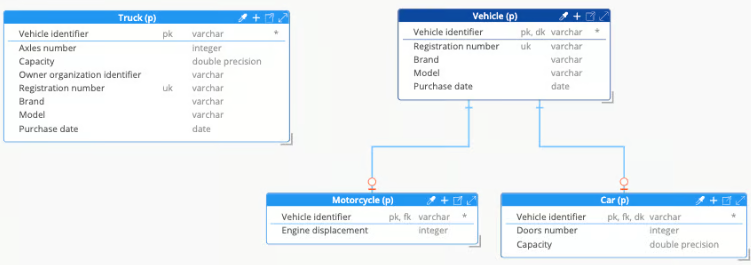
The derive operation applies the strategy of each supertype-subtype pair independently. Setting an exception on the Truck entity has no effect for the Car and Motorcycle tables.