

Materialize a supertype group when deriving from Polyglot
A supertype group describes a hierarchy. A database must physically store that hierarchy in a concrete shape, and several shapes are possible for the same group. The transformation happens during the derive operation from Polyglot. That's when your supertype group stops being a hierarchy and becomes physical tables with columns and constraints that the target understands.
The Materialization section of the group, in the Polyglot model, is where you tell the shape you expect from the derive operation. .
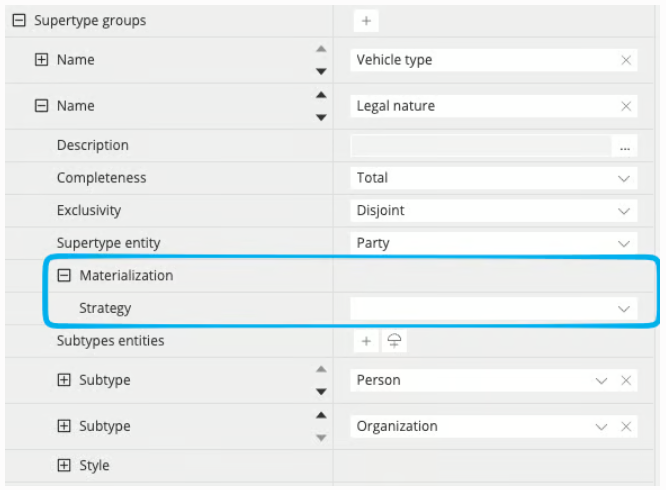
The strategy property
Select a supertype group and open its Materialization section. The Strategy property is where you choose the strategy that defines the shape downstream:
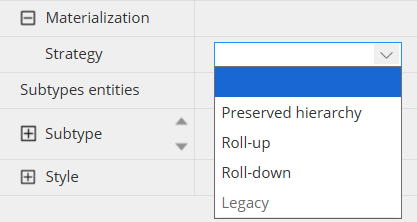
Three values (yes, 3...) are available:
- Preserved hierarchy keeps the supertype and each subtype as entities of their own, tied together by foreign keys
- Roll-down removes the supertype and copies its attributes into each subtype
- Roll-up does the opposite, and brings the attributes of the subtypes into the supertype
The property can also remain empty, which is not a fourth shape but the absence of a choice. When the Strategy property is left empty, each target applies the default of its own family: relational targets keep the supertype and its subtypes as separate entities linked by foreign keys, and document-oriented targets nest the subtypes inside the supertype (nested roll-up).
A fourth value, Legacy, appears in the list but cannot be selected. It only concerns data models build with Hackolade Studio versions v8.12.11 or before, when a simpler parent-child implementation was in place. See more details in this page.
The next pages detail each strategy with a concrete example, to showcase the effects: the entities you get, what happens to your primary and unique keys, and what the existing relationships involving supertypes and subtypes become.
Where to set the strategy
The property belongs to the subtype group, in the Polyglot model. What you set there is the strategy used when you derive, unless you pick a different fallback in the derive dialog.
See Derive a Polyglot model with supertype groups for Fallback materialization (if not set in Polyglot) and Apply fallback to all supertype groups.