

Derive with Roll-down strategy
This roll-down inheritance strategy is sometimes known as concrete table inheritance: each concrete subtype is stored in its own table, including both inherited and subtype-specific attributes. Generally, a separate supertype table is no longer required in the physical model (except if the group is partial.) Reading individual subtypes is simple, but common attributes are duplicated and querying across the hierarchy is harder. Roll-down means pushing the supertype attributes down into each subtype table. The supertype table disappears (unless completeness is partial), and each subtype contains both inherited and subtype-specific attributes.
Roll-down is attractive when applications mostly work with concrete subtypes independently, and when applications rarely query the supertype across all subtypes. The roll-down strategy also avoids joins for subtype queries, but duplicates inherited attributes across subtype tables and makes cross-subtype queries more cumbersome. It is generally easier to use when specialization is total/complete, because otherwise there may be valid supertype instances that have nowhere to be stored.
This roll-down strategy gives each subtype table everything it needs to stand alone. The attributes of the supertype are copied into every subtype, and the supertype entity itself usually disappears from the derived model, again unless completeness is partial. There is no foreign key to follow, and no join to write: a person is one row in one table.
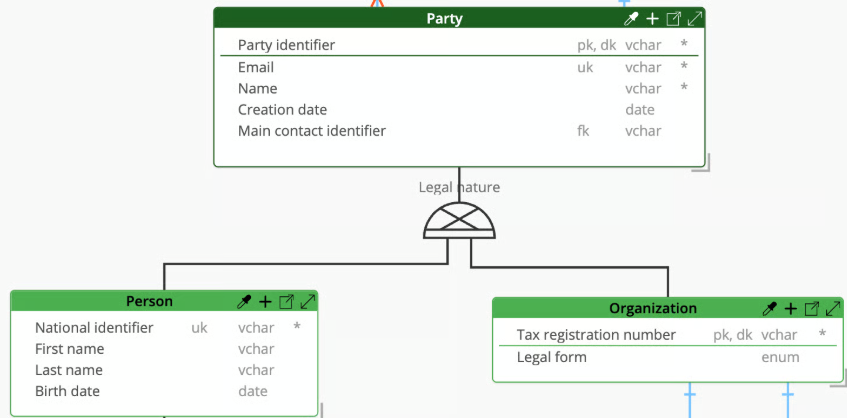
In the example, we work with the group built earlier: the Party entity as the supertype, with a party identifier attribute as primary key and an email attribute as unique key; the Person entity as a subtype, with a unique key constraint on its national identifier; the Organization entity as a subtype, with its own primary key, the tax registration number. Legal nature is total and disjoint.
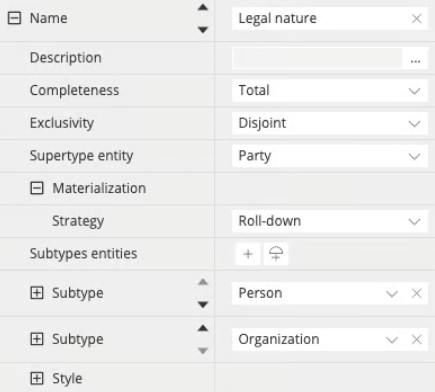
In the Properties Pane of the supertype group of the Polyglot data model, assuming you set the Strategy property to Roll-down
Then you you create, for example here a PostgreSQL physical data model derived from the Polyglot model.
Derive operation result
In the physical data model, the derive operation results in 2 tables, Person and Organization, each carrying its own columns, plus those it inherited from the Party entity in the parent Polyglot model:
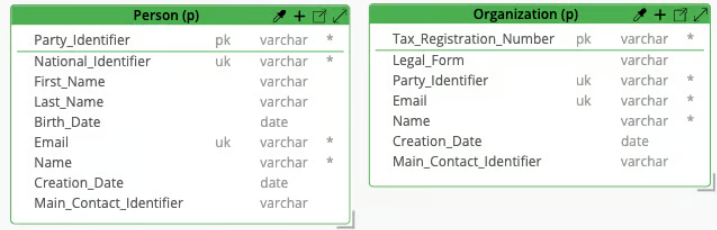
The Party entity is gone, but nothing was lost: every party is a person or an organization, and each table contains the columns previously in the Party entity: Party identifier, Email, Name, Creation data, and Main contact identifier.
Primary and Unique keys
The supertype identifier, if any, is copied into each subtype, following a logic similar to the one in the Preserved hierarchy strategy:
- if the subtype has no primary key of its own, the rolled-down supertype identifier gets added as the primary key of the subtype table. This is the case for the Person table.
- if the subtype has its own primary key, that key is kept and the rolled-down supertype identifier becomes a unique key. This is the case for the Organization table, which keeps its tax registration number as primary key.
The unique key for the email column is copied into both tables and stays a unique key in each of them. Attributes that were required remain required, since a value existed for every party.
Note: a unique key copied this way is enforced within each table, not across them. Nothing prevents a row of the Person table and a row of the Organization table from carrying the same email. Global uniqueness is what you give up when you choose this materialization strategy.
Relationships that pointed at the supertype
A foreign key relationship attached to the supertype (which disappears) follows the roll-down to become foreign key relationship(s) into the subtype(s).
Consider this example: parties have addresses. An Address entity contains a street, a postal code and a city, and it is linked to the party to which it belongs: an address always belongs to one party, and a party may have several addresses, so the relationship cardinality is 1 on the Party side and 0..n on the Address side.
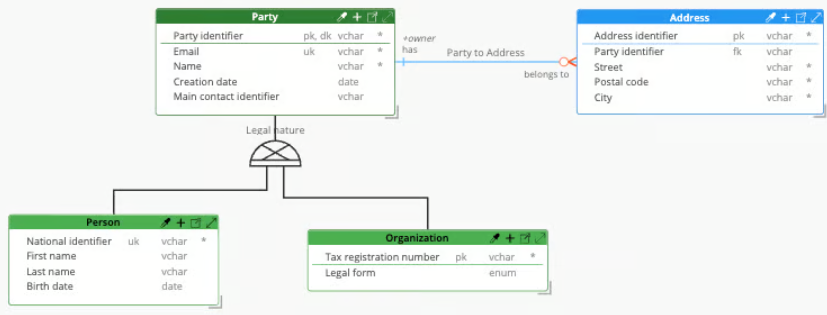
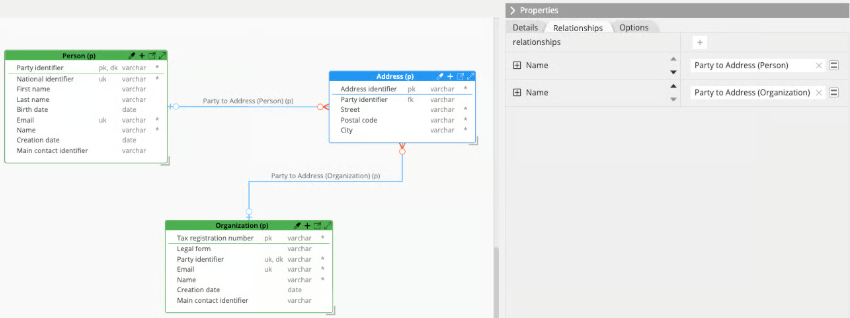
Because the Party entity disappears in the derived model, the foreign key relationship cannot be kept as it is. It becomes two foreign key relationships, one towards the Person table and one towards the Organization table:
About cardinalities
You may have noticed that the cardinality changed during the operation: the 1 on the Party side becomes 0..1 in each of the two relationships. An address still belongs to exactly one party, but that party is now a row in one of the two tables only, so neither relationship can require a match on its own.
The same happens to any relationship attached to the supertype, in either direction. A cardinality that was already optional remains as it was; a 1 becomes a 0..1, and a 1..n becomes a 0..n.
About the names
Both relationships come from the same one you defined in the Polyglot model, so they keep that name, plus a suffix in parentheses is added to tell them apart. The suffix is the name of the subtype involved. Here, "Party to Address" becomes "Party to Address (Person)" and "Party to Address (Organization)". When the roll-down produces only one relationship, there is nothing to distinguish, and the name remains unchanged.
Completeness determines whether the supertype survives
Take another supertype group example: the Vehicle entity, with Car, Truck and Motorcycle as its subtypes.
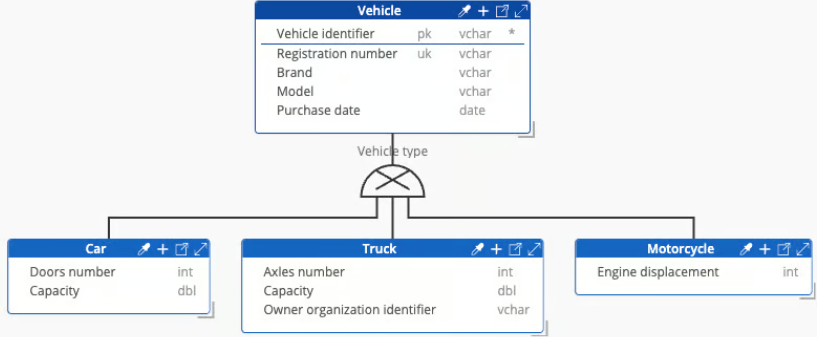
In this example the group is declared partial, because the fleet also contains trailers. A trailer is a vehicle, it has a registration number, a brand and a purchase date, and nothing more to record; it is none of the three declared subtypes. Another company modeling the same hierarchy might well declare the supertype group with a total completeness. This is a design choice, made case by case.
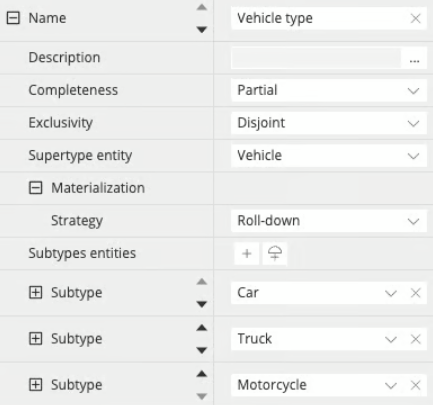
When this model gets derived with the roll-down strategy, the Vehicle table remains in the derived model, next to the Car, Truck, and Motorcycle tables:
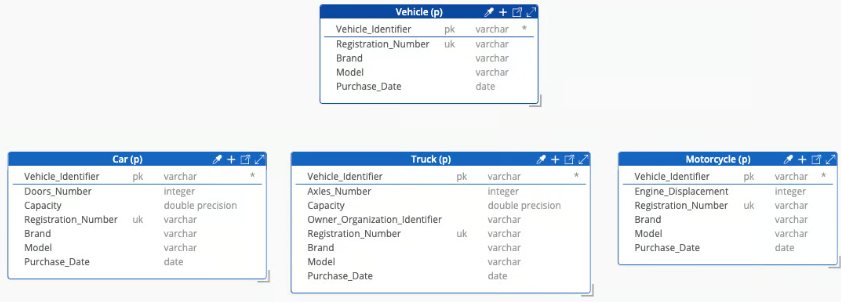
The Vehicle table gets derived because the group says that vehicles belonging to no subtype exist, and those rows need a table. Nothing was decided at derivation time; the derivation only follows what the group declares.
Note that there is no foreign key relationship between the subtype tables and the supertype table. The reason is as follows: given the roll-down strategy, each of the subtype table is self standing, with each containing all the necessary columns inherited from the supertype attributes. But because completeness was set as partial, there is a need for the Vehicle table so it can store rows related to vehicles that are specifically not a car, not a truck, and not a motorcycle.
Major difference with the Preserved hierarchy strategy
The Vehicle table here is not the same as after the derive operation using the Preserved hierarchy strategy.
With the materialization strategy "Preserved hierarchy", a car would occupy two rows: one in the Vehicle table for the common part, one in the Car table for the specific part, joined by a foreign key:
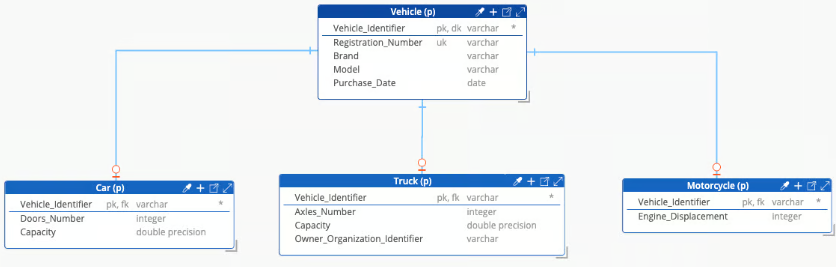
So the question to ask yourself is not whether you want to keep the supertype table. The question is: which shape your data should take:
- one row per object, in the table matching its nature, with the common attributes repeated in each table
- or a normalized shape, with the common part in one place and a join to reach the specific part
The first option corresponds to the roll-down strategy, the second to the Preserved hierarchy strategy. Both strategies keep a supertype table when the group is partial, but they do not result in the same rows.