
Union types in Avro
In Avro, union types are used to represent alternative data types for a field. They play a key role in schema evolution and compatibility, and in modeling logical choices such as oneOf.
Because Avro does not support explicit notions of “required” or “optional” fields, all fields are technically required. Logical optionality is expressed through unions, most commonly by allowing null as a polymorphic data type. When combined with a default value, this mechanism also supports forward- and backward-compatibility, enabling readers to safely handle data written with older versions of a schema that did not yet include the field.
Simple (scalar) union types
When working with scalar types (such as boolean, int, long, float, double, bytes, and string), compatibility is achieved by creating a union that combines null with one or more scalar types. In Hackolade Studio, this is achieved by adding multiple data types to the field. The field remains physically present in the schema, but its value may be null for example.
For compatibility, a default value can be defined. The default is used only by readers when the field is missing in data written with an older schema. The default value must be compatible with the first type listed in the union. For this reason, when null is intended to be the default, it must appear as the first type in the union and the default value must be set to null.
How unions are modeled in Hackolade Studio differs depending on whether only scalar types are involved or whether complex types are present, as explained in the following sections.
Union types and oneOf in Hackolade Studio
In Hackolade Studio, the oneOf choice is used to model an Avro union when at least one of the possible data types is complex type (meaning a record, an array, or a map);
A oneOf construct represents an exclusive choice: at runtime, the value must conform to exactly one of the defined alternatives.
Named types and naming rules
According to the Avro specification, only named types require a name. Named types are the data types: record, enum, and fixed. Whenever one of these types is used, a name is mandatory, regardless of whether the type is defined at the top level, inline, or inside a union.
Other types such as primitive (scalar) types (string, int, etc.), array, and map are not named types. They do not require a name, and the Avro specification does not define a name attribute for them.
In an Avro union, each branch must resolve to a distinct type. For named types, this distinction is based on the full name, which is the combination of the type name and its namespace. As a consequence, a union may contain multiple records, enums, or fixed types only if each of them has a unique full name. Two named types with the same full name (name and namespace) are considered identical by Avro and are not allowed in the same union. If multiple named types inside the same oneOf resolve to the same full name, the resulting Avro schema is invalid. The data modeler must ensure that all named types are unique to avoid a validation error.
Naming the union field
When generating an Avro schema, the union itself is always represented by a named field.
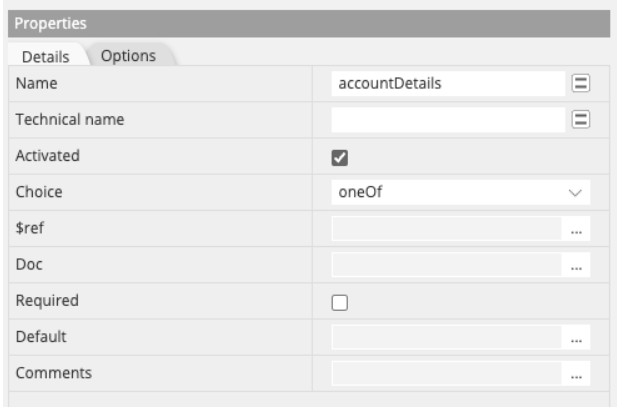
If the oneOf choice has an explicit name, that name is used as the name of the union field in the Avro schema. If no name is provided at the oneOf level, Hackolade Studio deterministically uses the name of the first subschema in the oneOf choice. For clarity and maintainability, it is strongly recommended to explicitly assign a name to the oneOf field.
Naming the types inside a oneOf
For each subschema in a oneOf choice that corresponds to a named Avro type (record, enum, or fixed), Hackolade Studio must generate a valid Avro type name.
If the user provides a Type name property on the subschema, that value is used as the Avro type name. If no explicit type name is provided, the name of the subschema is used. When a subschema is a reference to an existing definition, the name of the referenced definition is used.
All named types within the same union must have distinct full names. If this condition is not met, the resulting Avro schema is invalid and must be corrected by the user.
Example: oneOf choice with multiple record variants
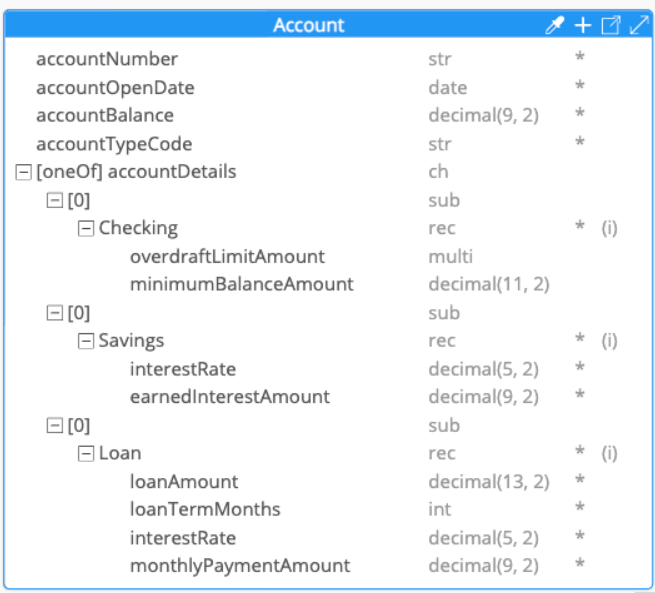
In the following example, let's focus on the accountDetails field. This oneOf choice illustrates a case, similar to relational supertype-subtype inheritance, where a sub record can take several alternative shapes, each represented by a different record type. Because these alternatives have different structures, this is a true alternative shape scenario and the oneOf must be explicitly named. The name accountDetails is used as the union field name in the Avro schema.
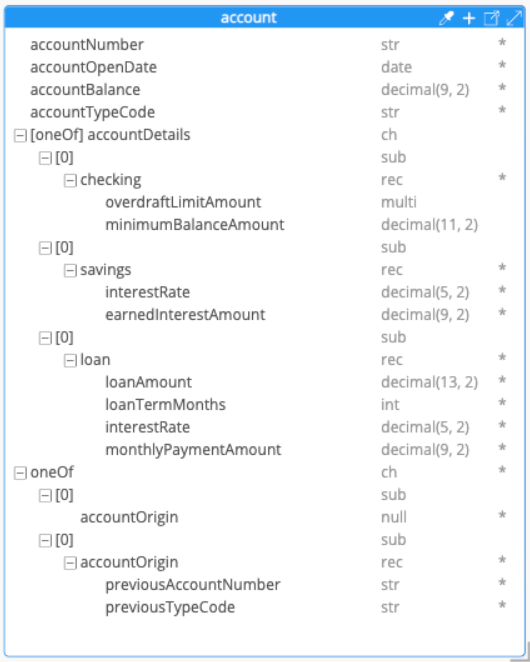
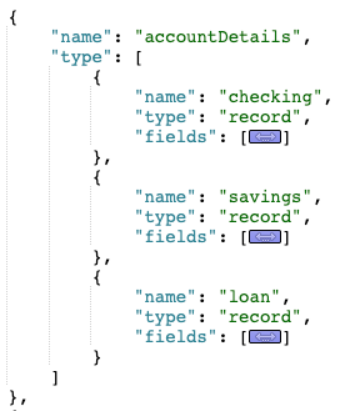
Each subschema in the oneOf choice is a named record. These names (Checking, Savings, Loan) are used as the Avro type names for the corresponding union branches. All named types must be unique within the union.
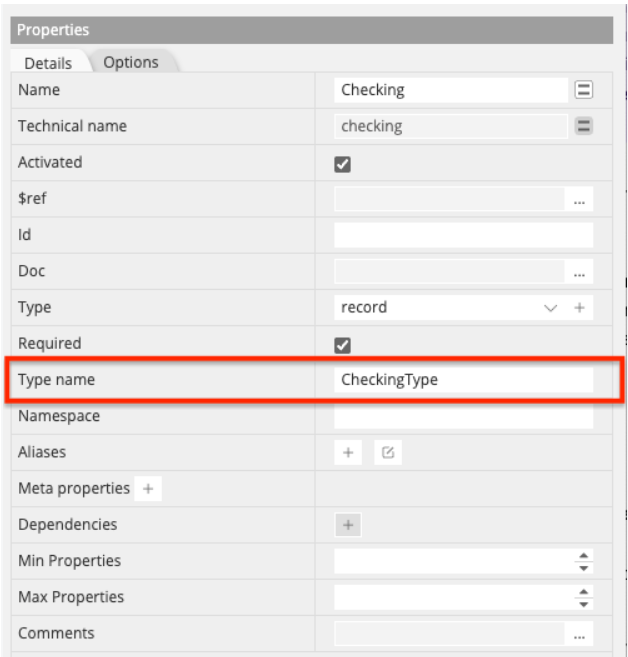
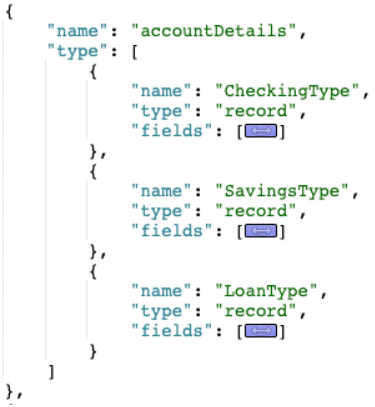
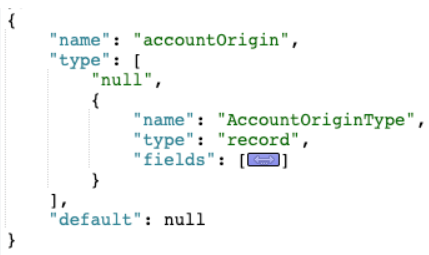
If a different Avro type name is required, the user can explicitly specify it in the Properties Pane using the Type name property. For example, the subschemas may be named checking, savings, and loan in the model, while the generated Avro types are named CheckingType, SavingsType, and LoanType. This allows the name of the subschema and the name of the Avro type to be controlled independently, while still producing a valid Avro union.
Example: oneOf choice with null and a record
In the following example, let's focus now on the accountOrigin field. This oneOf choice illustrates a different pattern, where the same logical concept can either be absent (null) or present with a defined structure. This is done for purposes of compatibility during evolution. Unlike the previous example, this is not a case of multiple alternative shapes, but a single concept with an optional structured value.
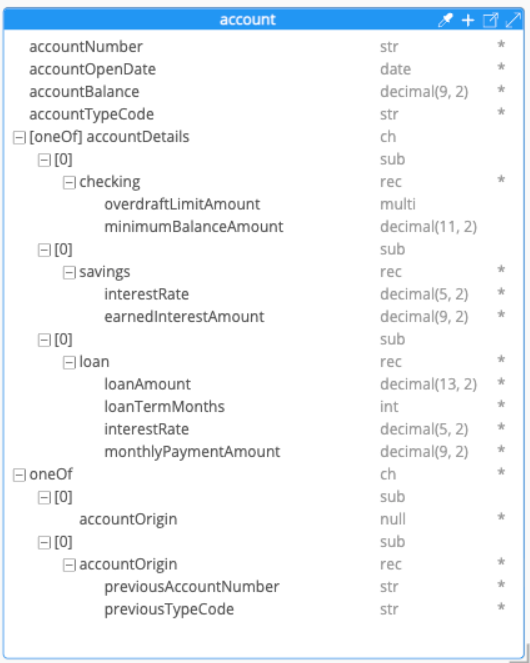
In this case, it is not strictly necessary for the user to explicitly name the oneOf field. Both subschemas intentionally share the same name (accountOrigin), emphasizing that this is always the same concept, whether it is null or structured.
When no explicit oneOf name is provided, Hackolade Studio uses the name of the first subschema as the name of the generated union field. This results in a consistent field name across the schema while still producing a valid Avro union.
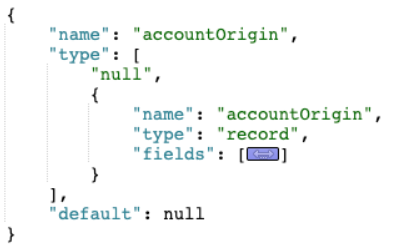
If the user wants a specific Avro type name without changing the subschema name, this can be done via the Type name property in the Properties Pane. This results in a consistent field name across the schema while allowing full control over the generated named types.

Polyglot derive operation and inheritance
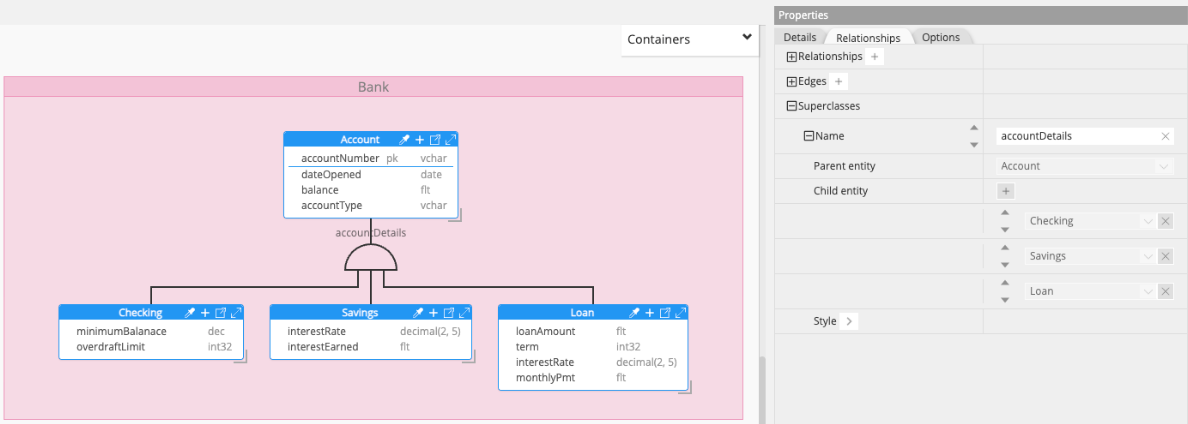
In a Polyglot model, inheritance is expressed through a supertype–subtype relationship. A supertype defines the common structure, while each subtype represents a specialized form with its own attributes. When such an inheritance is derived to Avro, it is mapped to a oneOf choice (union) of complex types, because each subtype becomes a distinct Avro record.
This derivation corresponds to the same pattern as the oneOf with multiple record variants example shown above. For instance, an inheritance where Account is specialized into Checking, Savings, and Loan will result in a union of record types, typically named accountDetails in the Avro schema.
In this scenario, it is important that the supertype–subtype relationship itself has a clear and explicit name in the Polyglot model. That name is used to generate the union field name in Avro. If the inheritance is unnamed, or ambiguously named, the generated Avro schema may be unclear or invalid, because multiple alternative shapes are involved.