

One supertype with multiple groups
The same supertype can be split along several axes of specialization at once. Each axis is a group of its own, with its own subtypes, its own characteristics, and its own strategy.
Two supertype groups sharing the same entity as supertype
A Party has a legal nature, a Person or an Organization, and it can also have a business role, a Customer or a Supplier. These are two groups sharing the same supertype, and they answer different questions: knowing that a party is a person says nothing about whether it buys from you or sells to you.
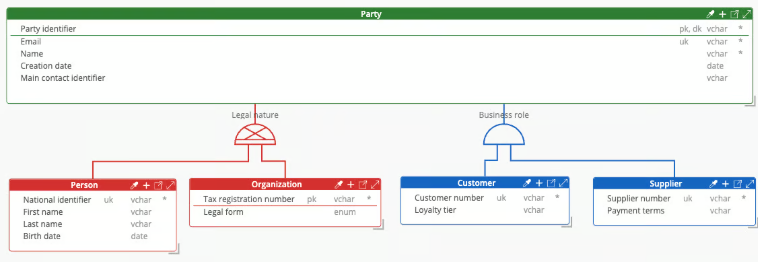
In our example, the supertype group Legal nature is total and disjoint, while supertype group Business role is partial and overlapping. One group says nothing about the other, and a party is classified on each axis independently.
Deriving several axes
Each group is derived with its own strategy, independently of the other. Below, the same two axes illustrate different combinations.
When all axes are set to Preserved hierarchy
With both groups on Preserved hierarchy, the Party table ends up with four child tables: Person, Organization, Customer and Supplier.
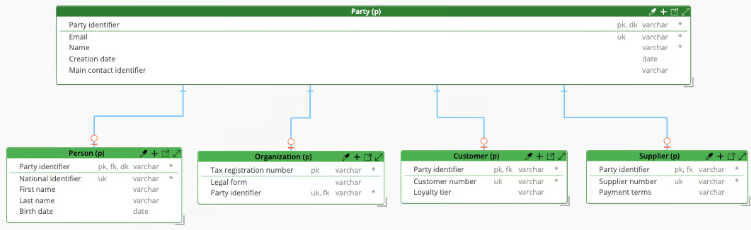
A party that is a person and a customer has a row in Party, one in Person and one in Customer.
When all axes are set to Roll-up
Both groups merge into the same entity, so the Party table contains the two classifications at once.
With the merge option set to Flat with Discriminator, you get the columns of the four subtypes together, with one discriminator per axis: the column you named for Legal nature, and the is_customer and is_supplier booleans for Business role, which is overlapping.
The merge option set to Nested is particular case. Each group produces its own choice inside the Party collection, with a oneOf choice for a disjoint group and an anyOf choice for an overlapping group, so two choices have to sit on the same node. JSON Schema does not allow two keys of the same name on one node, so Hackolade Studio groups them under an allOf, with one member per group:
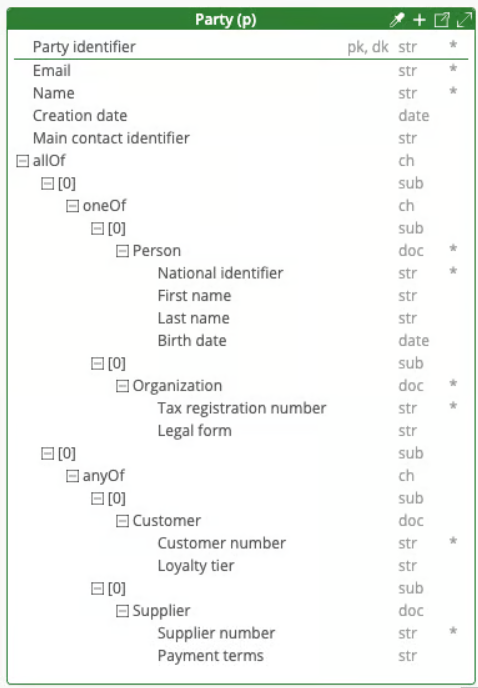
The allOf choice means that all the rules within it must be satisfied: the document must respect the legal nature choice and the business role choice. Each axis keeps its own completeness and its own exclusivity.
Mixing strategies across axes
It is not required for the two axes to be identical, whether in terms of strategy, completeness, or exclusivity. You may set Business role to Roll-up with the flat option, while Legal nature is set to Roll-down.
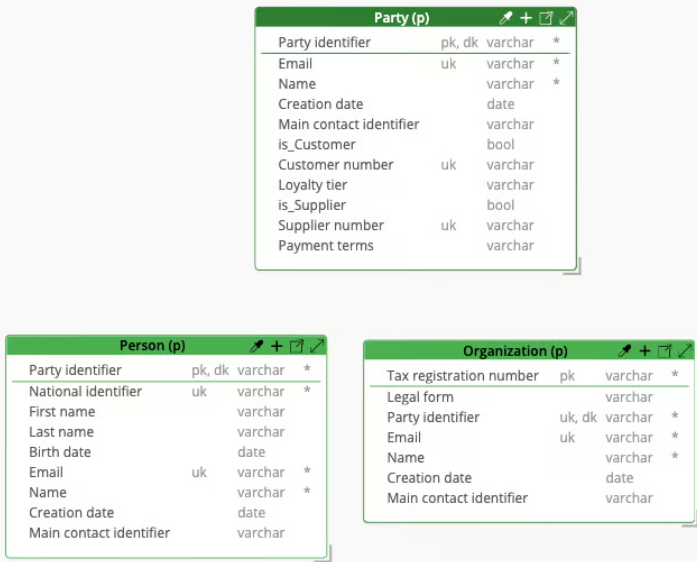
The Customer and Supplier table are absorbed within into the Party table, which now contains their attributes and the discriminator. The Party attributes are copied into the Person and Organization table.
One supertype per subtype
An entity can be the supertype of as many groups as your model needs. But an entity cannot have more than one supertypes.
A subtype is a particular case of the entity above it, and being the particular case of two different entities, each with its own axis, says something confused about what the entity is. If such a need appears, it usually reveals a modeling problem, and the answer is generally to keep one inheritance link and to express the other one as a plain relationship.