

Semantic layer
"How can consumers consistently access and leverage this meaning and knowledge?"
A semantic layer is the operational bridge between enterprise data assets and their consumption by humans, applications, and AI agents.
Whereas a semantic model, an ontology, and a knowledge graph are representations of meaning and knowledge, a semantic layer is an architectural layer that makes these representations accessible and actionable. It abstracts the complexity of underlying data sources, exposes consistent business concepts and definitions, and provides mechanisms for discovering, accessing, querying, and interpreting data without requiring consumers to understand its physical implementation.
A semantic layer can leverage semantic models, ontologies, and knowledge graphs, but does not necessarily require all three.
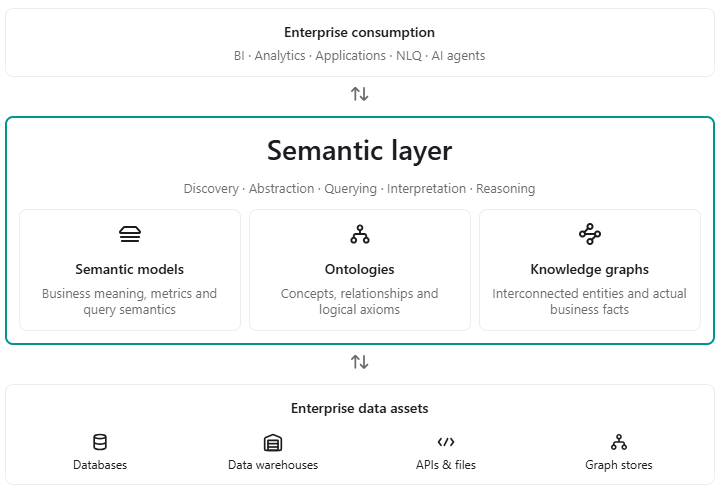
Distinguishing the five concepts
| Concept | Fundamental question |
|---|---|
| Taxonomy | How are business concepts classified and organized? |
| Semantic model | What does this data mean, and how should it be queried? |
| Ontology | What concepts exist in the business, and how can they relate? |
| Knowledge graph | What are the actual entities, facts, and relationships? |
| Semantic layer | How can consumers consistently access and leverage this meaning and knowledge? |
Where Hackolade fits
It is important to make a strategic distinction between defining a semantic layer and operating a semantic layer.
Hackolade Studio is positioned as the technology-independent design and governance environment for the semantic metadata that powers semantic layers. It is where business semantics are captured, formalized, maintained, versioned, and transformed into representations that can be deployed to different runtime technologies.
Hackolade is not tied to a particular semantic layer implementation or query engine. Instead, Hackolade is positioned upstream, as the design-time foundation for enterprise semantic layers, ontologies, and knowledge graphs, independent of the technologies chosen to operationalize them.